
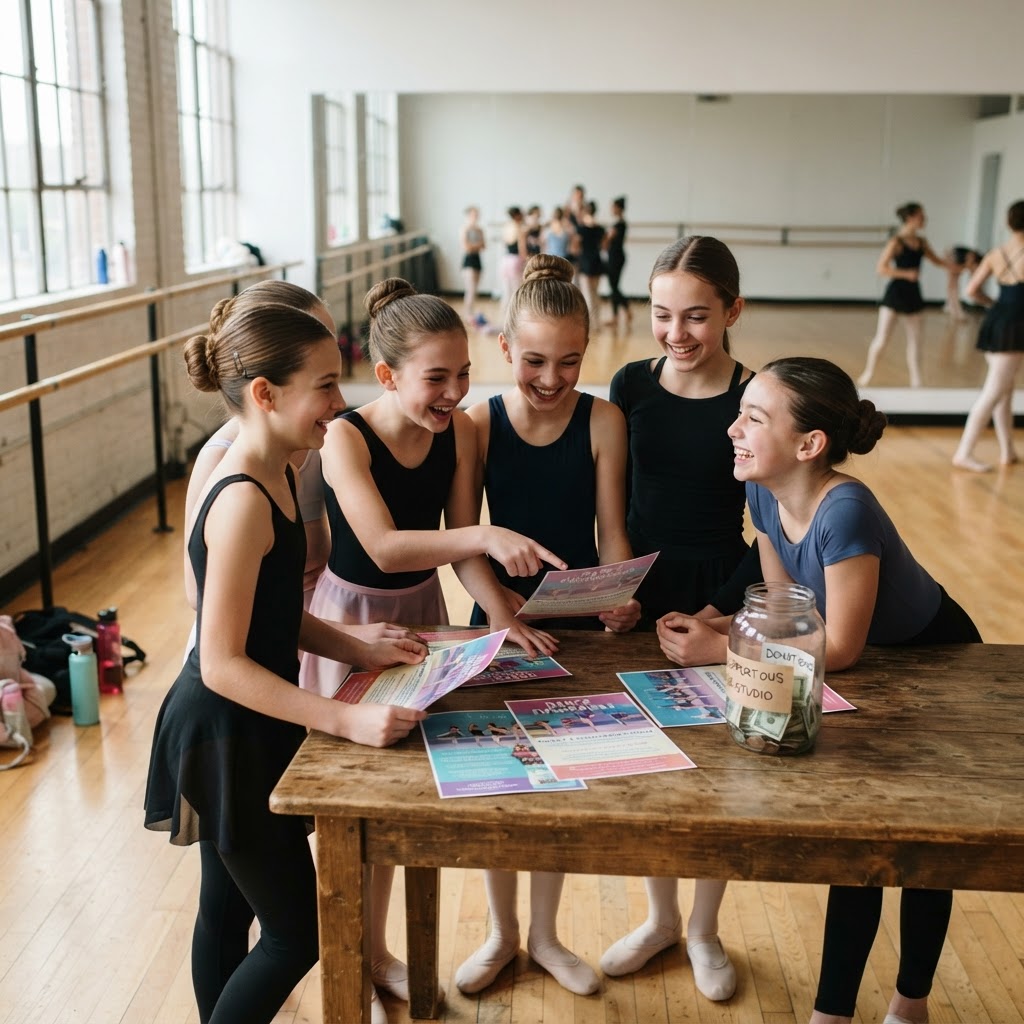
If you run a competition team or help organize fundraising for a dance studio, you already know the math is brutal. Competitive dance is one of the most expensive youth activities in North America. Dance Parent 101's real-family cost breakdown documents one family paying $6,295 minimum for a single season of competition and choreography fees covering five dances, on top of monthly tuition of $280 for technique classes, convention weekends at $200 to $275 each, and solo costumes running $100 to $500. Their conclusion: competitive dance in the USA "easily starts with prices in the $1,500 range and can far exceed $10,000 annually."
Other sources land in the same territory. Second Stage Dance estimates $7,500 to $8,000 per year as a typical figure for competitive dancers, and notes that raising a dancer from age 3 to 18 can pass $100,000 in total. Oro Dance's competition cost guide puts entry fees at $30 to $50 per routine for local competitions and $100 or more for nationals, with hair, makeup, and accessories adding another $50 to $100 per event.
Those bills do not land on a school district or a well-funded booster organization. They land on individual dance families, and the fundraising that softens them is almost always run by the same people paying them: a studio owner who is already teaching 30 hours a week, or a small group of parent volunteers juggling the fundraiser between work and carpool. This guide looks honestly at the product fundraising options available to dance studios and competition teams in 2026, what each one really nets, and how much volunteer effort each one demands.
What dance teams are actually fundraising for
Before comparing options, it helps to be clear about the target. Most studio fundraisers exist to offset a specific cluster of costs:
Competition entry fees are the big recurring one. At $30 to $50 per routine locally and $100 or more at nationals, a dancer competing in five or six routines across four competitions can generate over $1,000 in entry fees alone in a season, per the Oro Dance figures.
Costumes come next. Group costumes are often bundled into team fees, but solo, duo, and trio costumes run $100 to $500 each, sometimes more for elaborate designs.
Convention weekends at $200 to $275 per dancer, travel and hotels for nationals, and extras like competition bags, garment bags, and makeup kits (one family documented $60 in makeup and $73 in garment bags alone) round out the list.
A realistic team fundraising goal is usually $3,000 to $10,000 per season depending on team size and how far the team travels. That number matters, because it determines whether a given fundraiser can even reach the goal at a volunteer effort level parents can sustain.
Product fundraising options for dance studios, ranked honestly
This section compares product fundraisers only, meaning fundraisers where supporters pay money and receive something real in return. Donation drives and pledge platforms are a different category entirely, with different mechanics and different supporter psychology, and we will not try to rank them against product sales here.
The honest way to rank product fundraisers is by two numbers: what the team actually keeps per dollar raised, and how many volunteer hours it takes to run. Here is how the common options stack up for dance teams.
Butter Braid pastries
A staple of dance and cheer fundraising in the Midwest and beyond. Butter Braid's fundraising page states a per-item profit of $6.00, with the note that profit depends on the local dealership and may be higher. The pastries sell well because people like them, and the brochure-plus-delivery-day model is familiar. The catch is logistics: the product is frozen, so someone has to coordinate a delivery day, keep everything cold, and chase down families who forget pickup. Expect meaningful volunteer hours at the end even though selling is easy.
Cookie dough
Advertised at up to 55% profit on dance team programs at JustFundraising. Real net depends on the tier your group hits, since percentage typically scales with volume. Same frozen-logistics burden as pastries, plus tubs are bulky to distribute.
Chocolate bars
World's Finest Chocolate advertises up to 50% profit, no upfront cost when working with a local representative, and returns on unopened cases. This is one of the lowest-effort options on the list: dancers carry a box, sell bars for a few dollars each, and there is no delivery day. The limitation is transaction size. When each sale is a single candy bar, reaching a $5,000 team goal means a very large number of individual sales, which is a long grind for a 20-dancer team.
Little Caesars Pizza Kits
Little Caesars Pizza Kits. The official program states the group earns $6 per kit sold (retail prices per kit are not published on that page). Kits are easy to sell to families who would buy pizza anyway. Frozen delivery-day logistics apply.
Candles, popcorn, and snack brochures
JustFundraising lists candle programs at 50% profit and popcorn and pizza programs at 40%. These are fine middle-of-the-road options: decent margins, catalog-based selling, and another delivery day at the end.
Raffle tickets
Worth naming as the weak option in this category. Raffles feel high-margin because the tickets cost almost nothing to print, but in practice the team has to buy or solicit a prize worth winning, ticket prices are low, and in most US states and Canadian provinces raffles are regulated gambling that requires a license or permit, with rules that vary by jurisdiction (verify your local requirements before selling a single ticket). For a parent volunteer with limited hours, the compliance work and prize sourcing usually eat whatever margin advantage existed on paper. There are better uses of the same effort.
Two patterns show up across every option above. First, the supporter is usually buying out of obligation: most people do not need another tub of cookie dough, and everyone involved knows it. That is where fundraiser fatigue comes from, and dance families feel it acutely because studios often run multiple fundraisers per season. Second, almost every option ends in an inventory moment: cases to sort, freezers to borrow, orders to hand out at the studio between classes.
Where Donacelet fits for dance teams
Donacelet is a product fundraiser built around a different kind of product. Supporters buy a wristband, keychain, or virtual support code through your team's fundraiser, and each one comes with member-only Deals Access, a set of ongoing deals the supporter keeps using after your fundraiser ends. Here is how the published numbers compare on the two dimensions this guide has used throughout:
On margin: your team keeps $30 of every standard $60 sale, and $40 on referred sales. Per transaction, that is $30 to $40 to the team, versus $6 per Butter Braid pastry or pizza kit. A 20-dancer team where each dancer sells five wristbands nets $3,000 at the standard rate, which is real progress against a competition season's entry fees.
On effort: there are no upfront costs, setup takes 5 minutes, and there is no inventory, so there is no freezer day, no unsold cases, and no pickup coordination. Each fundraiser is linked to a specific team, and the money goes to that team, not to a general studio pot or parent association, which matters when different competition teams at the same studio carry different costs.
The honest framing for dance studios specifically: Donacelet works best when your supporter base values the deals enough to see $60 as a fair trade rather than pure charity. It is a bigger ask per transaction than a chocolate bar, so it suits fewer, warmer asks (family, coworkers, studio community) rather than high-volume cold selling outside a grocery store. Teams that want dancers doing hundreds of tiny transactions will still be better served by candy. Teams that want fewer transactions, higher net per sale, and zero inventory handling are the fit. You can see how it works or start a fundraiser at the Fundraisers page, and the FAQ covers the mechanics.
Timing your fundraiser around the dance calendar
Dance has an unusually predictable money calendar, and fundraising should track it.
September and October are the golden window. The season has started, families are engaged and optimistic, and the big competition invoices have not landed yet. Costume fees are typically collected in late fall and competition entry fees in December and January, so money raised in early fall arrives exactly when it is needed.
November works for anything with a holiday angle. Pastries, chocolate, and gift-ready products sell noticeably better before the holidays, and a wristband with ongoing deals is an easy gift suggestion for grandparents.
January through April is competition season. Families are exhausted, weekends are gone, and this is the worst time to launch anything requiring volunteer hours. If a spring fundraiser is unavoidable, pick the lowest-logistics option available.
May and June are recital season, which brings its own captive audience. A short, simple fundraiser aimed at recital attendees can work, especially for teams raising money for summer nationals travel.
Two practical tips regardless of timing. First, set a per-dancer target instead of a vague team goal: "five sales per dancer" converts directly into dollars and gives families a finish line. Second, run one well-executed fundraiser per semester rather than four overlapping ones; fundraiser fatigue is real for the same 40 families being asked every time.
Frequently asked questions
How much money can a dance team realistically raise with a product fundraiser?
It depends on team size and product. Small-ticket products need very high volume: at 50% profit on low-priced candy bars, hundreds of sales still net only a few hundred dollars. A 20-dancer team selling five $60 Donacelet wristbands per dancer at $30 each nets $3,000, and brochure items like Butter Braid pastries net $6 each per the program page. Match the product's transaction size to your goal.
Who should run the fundraiser, the studio owner or parents?
For competition team fundraisers, a parent coordinator with the studio owner's blessing usually works best. The owner sets the goal and endorses the fundraiser to families; a parent volunteer handles the follow-up. Low-logistics fundraisers exist precisely so this job does not consume someone's season.
Do dance fundraiser proceeds go to the studio or to my dancer?
It varies by program and by studio policy. Some studios credit individual dancer accounts, others fund the team as a whole. With Donacelet, each fundraiser is linked to a specific team and the money goes to that team, so a studio with multiple competition teams can keep each team's fundraising separate. Ask your studio how credits are applied before you start selling anything.
Are raffles a good fundraiser for dance studios?
Usually not. Raffles are regulated gambling in most jurisdictions and typically require a license or permit, the team has to source a prize, and ticket prices are low. The compliance and prize costs usually erase the paper margin. A product fundraiser with a real margin per sale is a better use of the same volunteer hours.
When is the best time of year for a dance studio fundraiser?
Early fall, September and October, before costume and competition fees are due. A second, smaller window exists around the spring recital for teams funding nationals travel. Avoid launching during peak competition season, January through April.
What does Donacelet cost to start?
Nothing upfront. Setup takes about 5 minutes, supporters buy wristbands, keychains, or virtual support codes with member-only Deals Access, and your team keeps $30 per standard sale and $40 per referred sale. Details are on the FAQ page.