
The short answer: Hudl has not published what Hudl Fundraising costs. No platform fee, no percentage split, no processing costs appear in its launch announcement, its blog, or the acquisition coverage as of July 2026. This post tracks everything that is publicly known, and we will update it the day Hudl publishes numbers.
If you are evaluating Hudl Fundraising for your program, this is the page to bookmark, and the question list below is what to bring to your first rep call.
What Hudl has said
Hudl acquired TeamUp (Fund2Save, LLC) on July 8, 2026 and rebranded it Hudl Fundraising From Team Up. Its launch materials describe two formats, a fully managed Event and a self-led Fundraiser, and report that high school teams using the approach have averaged $8,000+ per event. Hudl footnotes that figure as gross revenue from events run between July 1, 2024 and July 1, 2026.
Note the word gross. An average of $8,000 raised per event says nothing about what a team keeps after the platform's share and any processing costs. That gap between gross and net is the single most important number in any fundraiser, and it is the one number not yet published.
TeamUp's pricing history
This is not new. Before the acquisition, TeamUp's own site described its programs with phrases about strong profits and minimal work but published no percentage or fee anywhere. Fund2Save ran the same playbook with PushSave, whose site promoted profit opportunity without a stated split.
To be fair, unpublished pricing is common in rep-driven fundraising. Fees in this category are often negotiated per program, varying by size, service level, and incentive packages. That flexibility can work in a large program's favor. It also means two similar teams can pay meaningfully different rates for the same product, and neither knows it.
The questions to ask a Hudl Fundraising rep
If your program takes a call, get every one of these in writing before you commit:
- What percentage of gross donations does the platform keep, for both the managed Event and the self-led Fundraiser?
- Are card processing fees included in that percentage or charged on top? Who pays them, the program or the donor?
- Are donors prompted to add a tip or cover fees at checkout, and where does that money go?
- What do athlete incentives or prizes cost, and who funds them?
- When does the program get paid, and is there a minimum before payout?
- Does the program need a Hudl subscription to use it, and does bundling change the rate?
- What contact information do athletes need to provide, and how will it be used afterward?
Question 7 matters more than it looks. Donation-outreach models depend on athletes sharing their personal networks, and families deserve to know how those contact lists are stored and used after the event ends.
How to compare cost across fundraising models
Percentages only mean something when you convert them to net dollars against your goal. The math for any fundraiser is the same:
Net to team = gross raised minus platform share minus processing minus incentive costs
For a donation-based event, you cannot run that math until a rep gives you the numbers above. For a product-based fundraiser, the math is usually visible upfront because the split per unit is fixed.
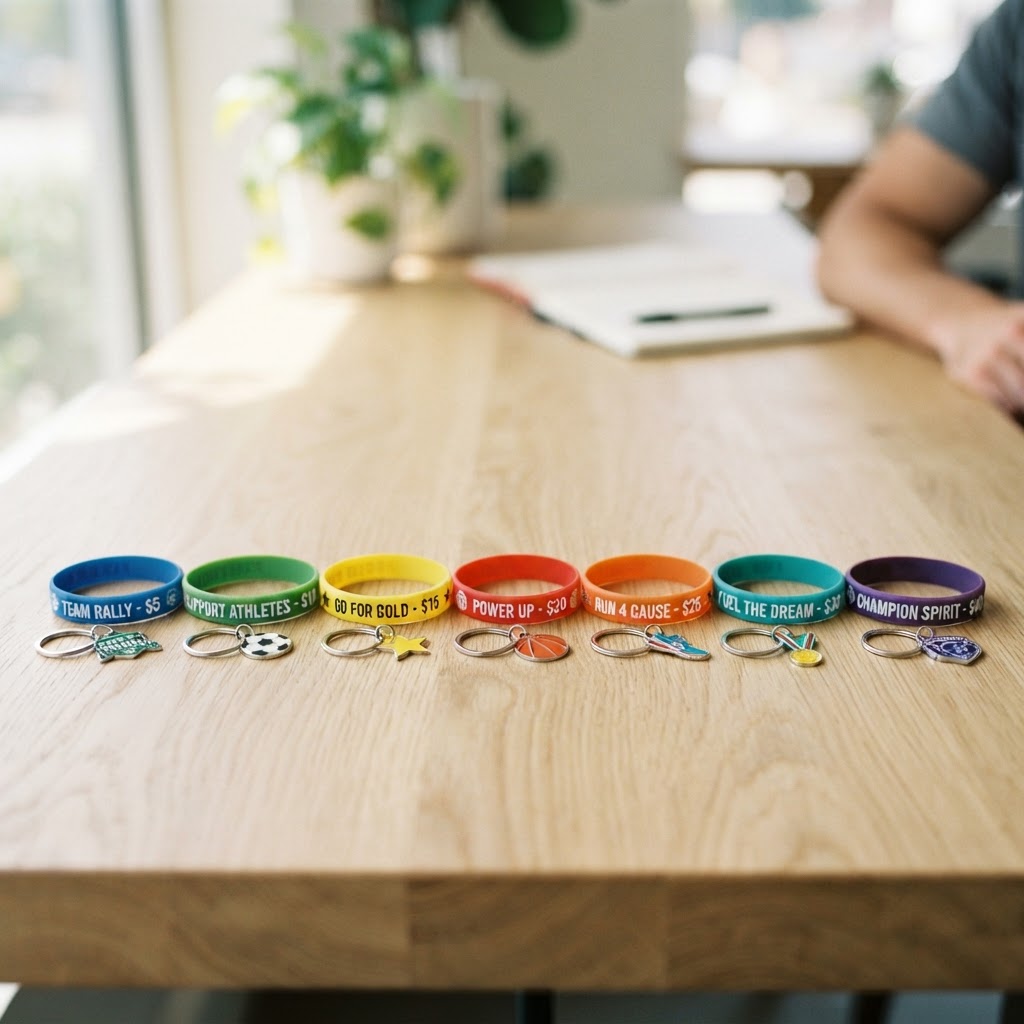
Donacelet publishes its numbers. Supporters buy a wristband, keychain, or virtual support code through your team's fundraiser and receive member-only Deals Access. Your team keeps $30 of every standard sale, and $40 when the sale comes through a player's referral link. There are no upfront costs, setup takes 5 minutes, and each fundraiser is linked to a specific team, so every dollar lands where supporters intend. You can run your own numbers for your roster size and goal before you talk to anyone.
That transparency difference is worth weighing on its own. A program can love the event format and still insist on knowing the net before signing. Any platform confident in its value should be able to put its split in writing.
The bottom line
Hudl Fundraising may turn out to be well priced. Right now nobody outside a sales call knows, because no number has been published, consistent with TeamUp's history before the acquisition. Until that changes, treat the $8,000+ average as what it is, a gross figure, and make any decision on the net your program would actually keep.
We check Hudl's published materials weekly and will update this post, with the date stamped above, as soon as pricing appears.
Comparing your options
If you are weighing several platforms, our 7 Hudl Fundraising alternatives comparison breaks down fees, payout speed, and what supporters actually get across seven options.